
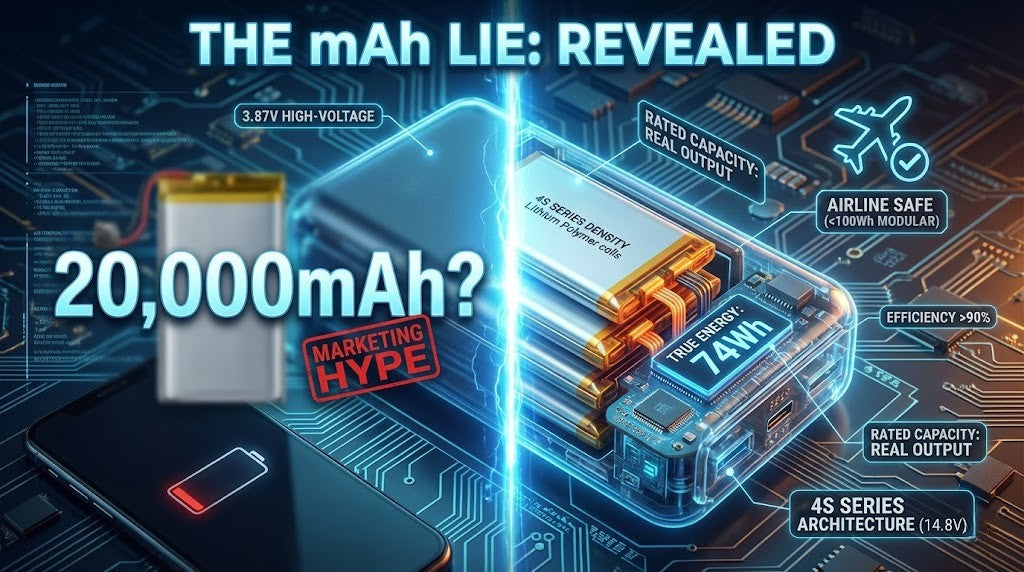
Introduction: Where Did My Battery Life Go?
You bought a power bank labeled "20,000mAh" to charge your phone, which has a 5,000mAh battery. Simple math suggests you should get 4 full charges, right?
But reality hits hard: you barely get 2.5 charges before the power bank dies.
You might think you bought a fake, or that your battery is degrading. But the truth is, mAh (milliamp-hour) only tells half the story.
mAh is a marketing metric. Wh (Watt-hour) is the physical truth.
In this hardcore guide, we will dismantle the marketing fluff and explain the physics manufacturers don't want you to know: Why "High-Voltage Cells" last longer, why "4S Architecture" is mandatory for laptops, and how to read specs like an engineer to avoid buying junk.
Part 1: mAh vs. Wh — The Physics of Truth
Most manufacturers love mAh because it produces big, impressive numbers. But mAh only measures electric charge, not energy. To know the size of the "fuel tank," you must look at Wh.
The Golden Formula:

Example:
A 10,000mAh power bank with a 3.7V battery cell:
10,000÷1000×3.7V=37Wh
This 37Wh is the real energy stored, which determines how many times it can charge your devices.
The Secret: 3.7V vs. 3.87V Cells
The industry standard for power bank cells is 3.7V. However, to achieve higher energy density in smaller frames, premium products (like the mfish E-Monster Series) utilize advanced 3.87V High-Voltage Cells.
Let's do the math on a small 0.17V difference:
- Standard 10,000mAh (3.7V): Total Energy = 37Wh
- mfish EM 10,000mAh (3.87V): Total Energy = 38.7Wh
The Insight: Even if the label says the same "10,000mAh," the 3.87V unit holds about 5% more physical energy. This is why some compact power banks seem to last forever, while bulky generic ones die quickly. Energy density is king.
Part 2: The Only Number That Matters — "Rated Capacity"
Stop using the "multiply by 0.8" rule of thumb to guess performance. Honest manufacturers print the truth in fine print on the back of the device: Rated Capacity.
"Rated Capacity" is the actual amount of power delivered to your phone (usually at 5V) after accounting for heat loss and voltage conversion.
- Battery Capacity: 10,000mAh — The fuel in the tank.
- Rated Capacity: ~6,000mAh — The fuel that actually reaches the engine.
Case Study: Look at the mfish 10000mAh EM. Its spec sheet clearly states: Battery Energy 38.7Wh, Rated Capacity 6000mAh.
This means the manufacturer isn't hiding the conversion loss. If a brand refuses to print "Rated Capacity" on the box, they are hiding inefficient circuitry. Avoid them.
Part 3: Advanced Selection — 1S vs. 4S Architecture
This is the dividing line between "toys" and "productivity tools." If you need to charge a MacBook, Windows ultrabook, or Switch, looking at mAh alone isn't enough; you must focus on the Series Architecture.
What is 14.8V (4S) Architecture?
Ordinary power banks use a single battery cell structure (1S, 3.7V). When charging a laptop (which usually requires 20V), the unit has to work frantically to boost the voltage—like a small horse trying to pull a heavy cart. This causes severe overheating and a massive drop in efficiency.
In contrast, professional laptop power banks (such as the mfish Super Mushroom Series) adopt a 4S Series Architecture.
- Internal Structure: 4 battery cells connected in series, bringing the base voltage directly to 14.8V.
- Advantage: Stepping up from 14.8V to 20V is effortless.
- Result: Lower current, significantly less heat, and extremely high conversion efficiency.

Buying Decision Table:
| Usage Scenario | Recommended Architecture | Typical Characteristics |
| Phone Only (iPhone/Android) | 1S (3.7V/3.87V) | Lightweight, runs cool. Example: mfish EM Series |
| Laptop Charging (MacBook/XPS) | 4S (14.8V) | Delivers full 65W/100W output without overheating. Example: mfish SM Series |
Pitfall Guide: If you frequently charge laptops, never buy a cheap 1S architecture "brick." It will not only charge slowly but also turn into a "hand warmer" due to overheating, effectively burning off the energy you paid for.
Part 4: Aviation Safety — The "Modular" Hack
Beyond performance, Wh determines if your gear gets confiscated at airport security.
The International "Carry-On" Rules:
- < 100Wh: Allowed without approval. (Unlimited quantity in most regions).
- 100Wh – 160Wh: Requires airline approval.
- > 160Wh: Strictly Prohibited.
This creates a dilemma: Power users want massive capacity (like 40,000mAh), but a single 40,000mAh battery would exceed 148Wh, making it illegal to fly with.
The mfish Solution: Modular Magnetic Design
This is why the mfish SM Series is engineered with exactly 74Wh. It sits comfortably below the 100Wh safety line.
But mfish solved the capacity problem with a brilliant Modular Magnetic Set:
You can magnetically snap two mfish SM units together.
- On your desk: You have a massive 40,000mAh power station to keep devices running for days.
- At the airport: You simply detach them.
Instead of carrying one illegal >100Wh brick, you are now carrying two separate, perfectly legal 74Wh batteries. This allows you to legally travel with 40,000mAh of total power without risking confiscation. It is the ultimate hack for power users who travel.
Conclusion: How to Buy Like an Engineer
To summarize, don't fall for the biggest number on the box. Follow these three rules:
- Check Wh & Voltage: Look for 3.87V High-Voltage cells for maximum energy in minimum size.
- Demand "Rated Capacity": If they don't list it, they are hiding poor efficiency.
- Match the Architecture:
- Charging a phone? 1S is fine.
- Charging a laptop? 4S (14.8V) is non-negotiable.
- Need massive power and travel safety? Look for Modular Designs (like the mfish SM magnetic set) that let you break the rules of physics without breaking the rules of the TSA.
Understand the specs, and you’ll never suffer from battery anxiety again.


Leave a comment
This site is protected by hCaptcha and the hCaptcha Privacy Policy and Terms of Service apply.